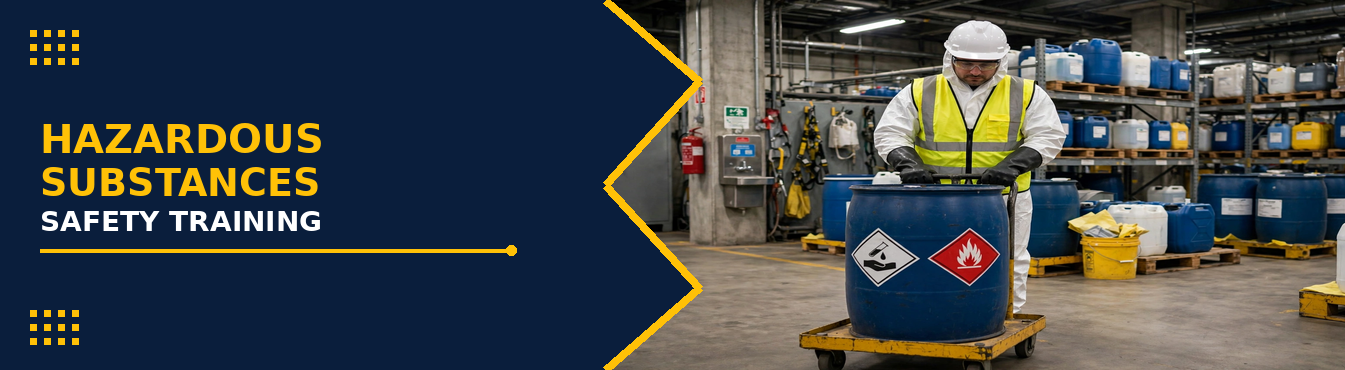
HAZARDOUS SUBSTANCES
Hazardous substances are materials that can cause harm to people, property or the environment when they are used, stored, transported or disposed of incorrectly. They can be found in many workplaces, including construction and manufacturing. Common examples include paint, paint thinner, solvents, petrol, diesel, LPG, acids, alkalis, cleaning chemicals, cement dust, silica dust, welding fumes, adhesives, pesticides and batteries. This training provides workers, supervisors and HSE personnel with the knowledge and skills needed to recognize, handle and respond safely to hazardous substances and to protect themselves, their coworkers and the environment.
TRAINING OBJECTIVES
- Raise awareness of hazardous substances and the risks they can create in the workplace.
- Understand the difference between health hazards and physical hazards.
- Understand the different routes by which hazardous substances can enter the human body.
- Learn how to read and interpret chemical labels, hazard pictograms and Safety Data Sheets (SDS).
- Select appropriate control measures and PPE for hazardous substances.
- Understand safe storage and handling practices for chemicals.
- Understand how to respond safely to chemical spills and emergencies.
- Encourage workers to identify and report unsafe conditions, leaks, spills and exposures.
LEARNING OUTCOMES
- Define hazardous substances and identify common examples used in the workplace.
- Recognize hazardous substances in different physical forms, including dusts, fumes, vapours, gases, liquids and solids.
- Understand the five main routes of entry into the body: inhalation, skin contact, ingestion, eye contact and injection.
- Recognize health hazards such as skin irritation, chemical burns, eye damage, respiratory problems, poisoning, dermatitis and long-term diseases.
- Recognize physical hazards such as fire, flash ignition, explosion, dangerous chemical reactions, corrosion and oxygen deficiency.
- Understand the information provided on chemical labels and GHS hazard pictograms.
- Understand the purpose and importance of Safety Data Sheets (SDS).
- Apply the hierarchy of controls, including elimination, substitution, engineering controls, administrative controls and PPE.
- Follow safe chemical storage and handling practices.
- Know what to do during a chemical spill and understand when specialist assistance is required.
- Avoid unsafe practices such as mixing unknown chemicals, using unlabeled containers, storing chemicals in food bottles, eating or drinking near chemicals, ignoring leaks and smelling chemicals directly.
BENEFITS OF TRAINING
Hazardous substances can cause both immediate and long-term harm if they are not properly identified, controlled, stored and handled. This training helps participants understand the hazards associated with chemicals and the ways in which exposure can occur. It promotes safe working practices, correct use of labels and SDS, suitable control measures and appropriate PPE. It also helps workers respond correctly to leaks, spills and chemical emergencies and report unsafe conditions before they develop into more serious incidents.
WHO CAN ATTEND THIS TRAINING?
- Workers who use or may be exposed to hazardous substances.
- Supervisors responsible for chemical-related activities.
- HSE personnel and safety officers.
- Emergency response team members.
- Personnel involved in chemical storage, handling or workplace inspections.
HOW WE DELIVER TRAINING
- PowerPoint presentations.
- One-to-one interaction and discussion.
- Practical discussion of chemical handling, storage and emergency response.
- End-of-section quiz/knowledge check.
- Question and answer session.
- Case study discussion, including paint thinner use in a poorly ventilated room.
ASSESSMENT
- The assessment of the learners is done through a multiple-choice questionnaire set to assess the learning approach and the understanding of what is taught to them.
Qualification
HAZARDOUS SUBSTANCES
Duration
One day and customised
Training Mode
Online / Classroom / In-company
Level
Language
English / Hindi
Prerequisites
None