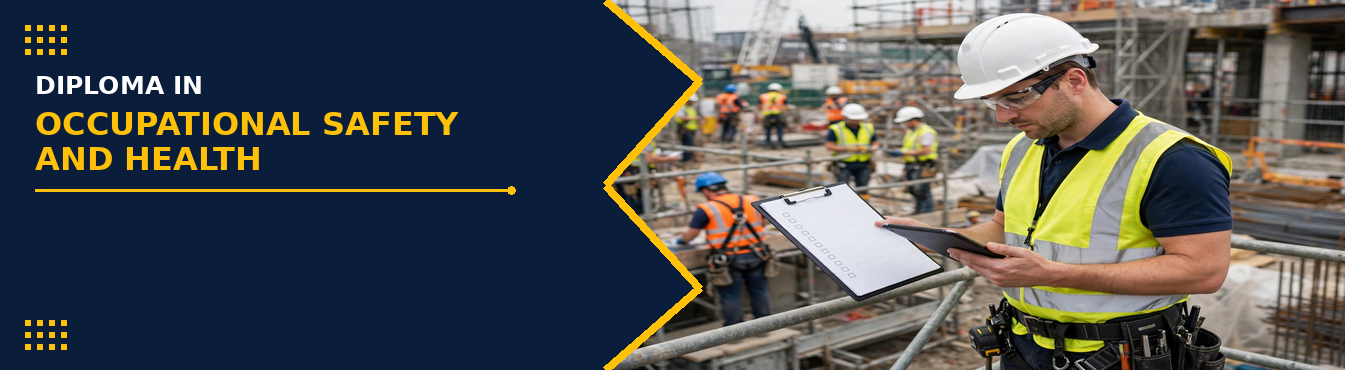
Diploma in Occupational Safety & Health
The Diploma in Occupational Safety and Health is designed to develop the knowledge and practical skills required to support employee well-being, workplace safety, environmental protection, and organisational risk management.
The program introduces learners to the principles of occupational health and safety, hazard identification, risk assessment, legal compliance, safety-management systems, workplace communication, and accident prevention. It is suitable for aspiring safety practitioners, working professionals, managers, supervisors, and individuals seeking to develop or advance a career in occupational safety and health.
The course combines academic knowledge with practical workplace applications, enabling learners to understand how health and safety systems can be designed, implemented, monitored, and continuously improved across different work environments.
Course Objectives
The Diploma in Occupational Safety and Health aims to:
- Develop a comprehensive understanding of occupational health, safety, environmental, and risk-management principles.
- Explain how workplace conditions can affect the physical, mental, and social well-being of employees.
- Equip learners to identify, assess, and control workplace hazards.
- Introduce methods for preventing accidents, occupational illnesses, injuries, and their consequences.
- Develop an understanding of physical, chemical, biological, ergonomic, and psychosocial risks.
- Familiarise learners with relevant legislation, industry standards, and professional best practices.
- Promote the integration of occupational health and safety into organisational policies and management systems.
- Develop effective safety procedures, emergency arrangements, and preventive programs.
- Strengthen learners’ ability to communicate safety information to employees, managers, and other stakeholders.
- Prepare individuals for professional roles in occupational safety, workplace health, risk management, and EHS-related fields.
Course Key Areas of Study
The program may cover the following key areas:
- Fundamentals of occupational safety and health
- Workplace health promotion and employee well-being
- Hazard identification and risk assessment
- Physical, chemical, biological, ergonomic, and psychosocial hazards
- Accident and incident prevention
- Occupational diseases and workplace exposure
- Industrial hygiene and workplace monitoring
- Safety-management systems
- Health, safety, and environmental legislation
- Industry standards, compliance, and best practices
- Emergency preparedness and response
- Workplace inspections and safety audits
- Safety procedures, policies, and documentation
- Safety performance measurement and data analysis
- Communication and consultation in workplace safety
- Ethical responsibilities of safety professionals
Career Opportunities
Occupational safety and health professionals are required in organisations that need to protect employees, comply with legal requirements, reduce workplace risks, and improve operational performance. Career opportunities may be available in:
- Manufacturing and engineering industries
- Construction and infrastructure projects
- Oil, gas, petrochemical, and energy sectors
- Chemical and pharmaceutical industries
- Healthcare organisations and hospitals
- Logistics, warehousing, and transportation companies
- Safety consultancy and professional training organisations
The qualification may also provide a foundation for further study and professional certification in occupational health, industrial safety, environmental management, risk management, or related disciplines.
Potential Job Roles
After completing the program, individuals may pursue entry-level or supervisory positions such as:
- Occupational Health and Safety Officer
- Health and Safety Officer
- Safety Supervisor
- EHS Coordinator
- Occupational Safety Assistant
- Safety Inspector
- Workplace Health and Safety Advisor
- Risk Assessment Assistant
- Safety Auditor
- Safety Training Coordinator
- Health and Safety Consultant
- Environmental, Health and Safety Assistant
- Safety Management System Coordinator
Job titles and responsibilities may vary according to the employer, sector, location, professional experience, and applicable regulatory requirements.
Benefits of the Program
Completing a Diploma in Occupational Safety and Health can provide the following benefits:
- Builds a strong foundation in workplace health and safety management.
- Develops the ability to identify, evaluate, and control different types of workplace hazards.
- Improves understanding of occupational health, employee well-being, and accident prevention.
- Strengthens knowledge of safety legislation, regulatory requirements, and industry practices.
- Supports the development and implementation of workplace safety systems and procedures.
- Enhances skills in data collection, workplace analysis, reporting, and safety performance evaluation.
- Develops the ability to communicate technical and regulatory information clearly.
- Improves competence in safety training, employee awareness, and workplace consultation.
- Encourages ethical, responsible, and professional safety practices.
- Provides a foundation for employment, career advancement, and further professional education.
Professional Development
The program supports professional development by helping learners apply occupational safety and health principles to practical workplace situations. Individuals can develop the ability to identify trends, analyse workplace information, establish priorities, and contribute to continuous improvement.
Course Outcome
After successfully completing the Diploma in Occupational Safety and Health, individuals should be able to:
- Explain the fundamental principles of occupational safety and health.
- Identify workplace hazards and assess associated risks.
- Recommend appropriate measures to eliminate, reduce, or control workplace risks.
- Recognise physical, chemical, biological, ergonomic, and psychosocial hazards.
- Support the implementation of safety policies, procedures, and management systems.
- Interpret and apply relevant legislation, standards, and workplace requirements.
- Assist with safety inspections, audits, monitoring, and compliance activities.
- Collect, organise, and analyse workplace safety data.
- Contribute to accident prevention, incident reporting, and corrective-action processes.
- Develop and deliver basic safety training and awareness programs.
- Communicate safety information effectively to employees, managers, and other stakeholders.
- Apply ethical principles and professional responsibility in safety-related work.
- Pursue entry-level and supervisory opportunities in occupational safety, workplace health, risk management, and EHS-related fields.
Qualification
Diploma in Occupational Safety and Health
Duration
One year
Training Mode
Online / Classroom
Board
UGC/Autonomous
Language
English / Hindi
Eligibility criteria
Candidates who have passed Class 10 or Class 12
Batch Mode
Exam Type