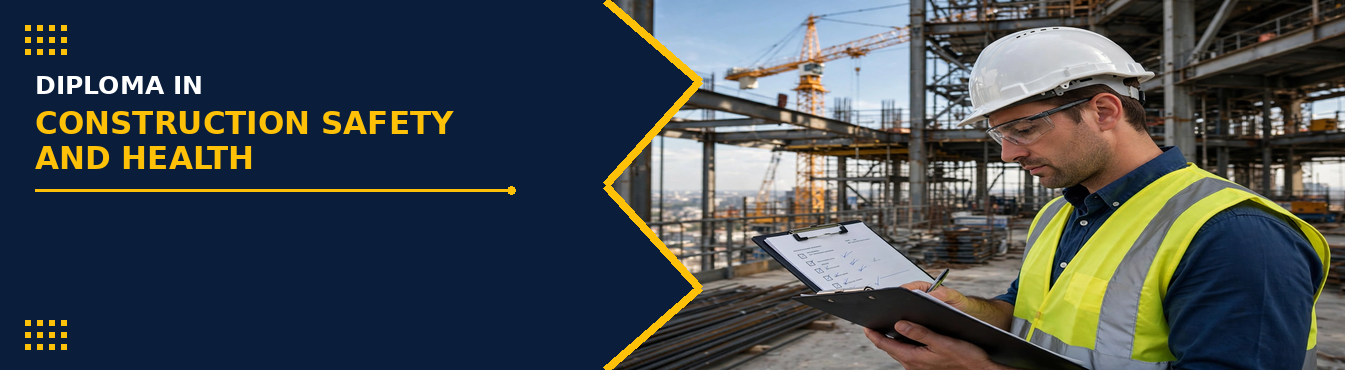
Diploma in Construction Safety & Health
The Diploma in Construction Safety and Health is designed to develop the knowledge and practical skills required to promote safe, healthy, and compliant construction workplaces. The program focuses on identifying and controlling construction-related hazards, preventing accidents, preparing for emergencies, managing occupational health, and implementing effective safety-management systems.
The course suits individuals seeking a career in construction safety, as well as supervisors, site engineers, project coordinators, contractors, managers, and other professionals involved in construction and infrastructure projects.
Learners gain an understanding of how to assess risks, implement preventive measures, conduct workplace inspections, promote safe work practices, and support compliance with applicable occupational safety and health requirements.
Course Objectives
The Diploma in Construction Safety and Health aims to:
- Develop a strong foundation in construction safety and occupational health principles.
- Enable learners to identify, assess, and control hazards at construction sites.
- Promote safe work practices and accident-prevention strategies.
- Develop an understanding of construction safety legislation, standards, and regulatory requirements.
- Explain the safe use of construction equipment, tools, machinery, and temporary structures.
- Introduce effective methods for site inspections, safety audits, and compliance monitoring.
- Develop knowledge of emergency preparedness, fire prevention, and incident response.
- Promote the protection of workers’ physical and mental well-being on construction sites.
- Strengthen safety communication, worker participation, and toolbox-talk practices.
- Prepare individuals to support the implementation of construction health and safety management systems.
Course Key Areas of Study
The program may cover the following key areas:
- Fundamentals of construction safety and health
- Construction safety management systems
- Hazard identification and risk assessment
- Construction safety legislation and regulatory compliance
- Site safety planning and safety documentation
- Electrical safety at construction sites
- Lifting operations, cranes, and material handling
- Chemical and hazardous-substance management
- Occupational health and industrial hygiene
- First aid and emergency preparedness
- Accident, incident, and near-miss investigation
- Construction-site inspections and safety audits
- Environmental protection and construction-site housekeeping
- Safety reporting, records, and performance monitoring
Career Opportunities
Construction safety professionals are required across residential, commercial, industrial, infrastructure, and civil-engineering projects. The qualification may support career opportunities in:
- Building construction projects
- Roads, highways, bridges, and transportation projects
- Railways, metros, and infrastructure development
- Industrial and commercial construction
- Real estate development
- Structural and civil-engineering projects
- Renovation, maintenance, and demolition work
- Safety consultancy and occupational health organisations
Potential Job Roles
After completing the program, individuals may pursue entry-level, technical, or supervisory positions such as:
- Construction Safety Officer
- Construction Safety Supervisor
- Site Safety Coordinator
- Health and Safety Officer
- EHS Coordinator
- Project Safety Assistant
- Site Safety Supervisor
- Safety Engineer Assistant
- Work-at-Height Safety Coordinator
- Scaffolding Safety Inspector
- Permit-to-Work Coordinator
- Safety Training Coordinator
- Risk Assessment Assistant
- Safety Auditor
- Incident Investigation Assistant
- Construction Compliance Coordinator
- Occupational Health and Safety Assistant
Benefits of the Program
Completing a Diploma in Construction Safety and Health can provide the following benefits:
- Builds a practical foundation in construction safety and occupational health.
- Develops the ability to identify and control common construction-site hazards.
- Improves understanding of safe work methods, site procedures, and risk controls.
- Strengthens knowledge of construction safety legislation and compliance requirements.
- Supports the implementation of site-specific health and safety plans.
- Enhances skills in workplace inspections, safety audits, and compliance monitoring.
- Develops awareness of work-at-height, excavation, lifting, electrical, and equipment-related risks.
- Improves competence in emergency planning, fire prevention, and incident response.
- Supports effective safety communication through inductions, toolbox talks, and worker training.
- Helps reduce accidents, injuries, property damage, delays, and project-related losses.
- Provides a foundation for employment and further professional development in construction safety and EHS management.
Professional Development
The program supports professional development by enabling learners to apply construction safety principles to real-world site conditions. Individuals can develop the ability to review work activities, identify unsafe conditions, recommend corrective actions, and contribute to the continuous improvement of safety performance.
Course Outcome
After successfully completing the Diploma in Construction Safety and Health, individuals should be able to:
- Explain the fundamental principles of construction safety and occupational health.
- Identify common hazards associated with construction activities and site conditions.
- Conduct basic hazard identification and risk assessments.
- Recommend suitable measures to eliminate, reduce, or control construction-related risks.
- Support the preparation and implementation of construction-site safety plans.
- Apply safe work practices for work at height, excavation, lifting, electrical work, hot work, and machinery operations.
- Recognise occupational health risks associated with dust, noise, vibration, chemicals, heat, and fatigue.
- Assist with site inspections, safety audits, and compliance monitoring.
- Support permit-to-work, contractor-management, and safe-work-procedure systems.
- Contribute to emergency preparedness, fire prevention, first-aid arrangements, and incident response.
- Assist in the reporting and investigation of accidents, incidents, and near misses.
- Maintain safety documentation, inspection records, reports, and corrective-action registers.
- Communicate safety requirements effectively to workers, supervisors, contractors, and project teams.
- Promote good housekeeping, environmental responsibility, and safe working conditions.
- Contribute to the continuous improvement of construction health and safety performance.
- Pursue entry-level and supervisory opportunities in construction safety, occupational health, and EHS-related fields.
Qualification
Diploma in Construction Safety and Health
Duration
One year
Training Mode
Online / Classroom
Board
UGC/Autonomous
Language
English / Hindi
Eligibility criteria
Candidates who have passed Class 10 or Class 12
Batch Mode
Exam Type