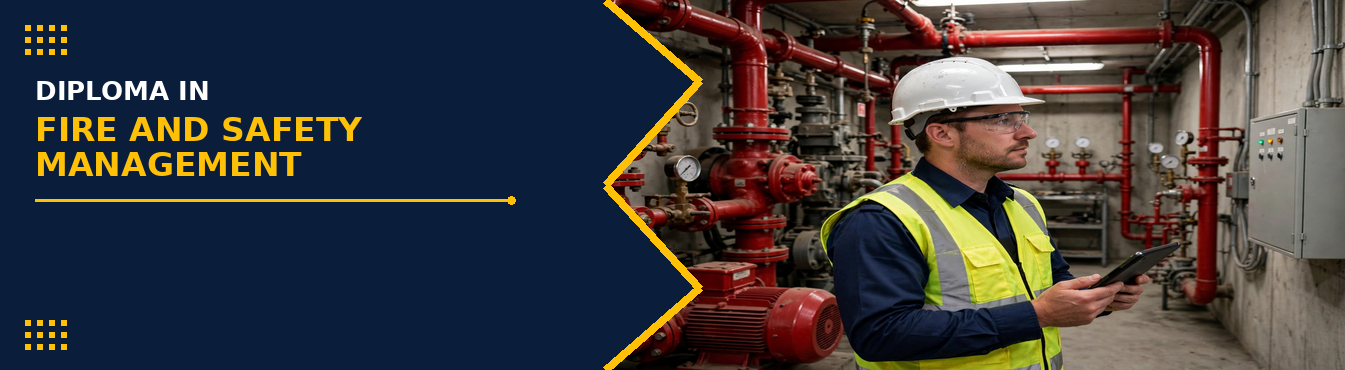
Diploma In Fire & Safety Management
The Diploma in Fire and Safety Management is designed to develop skilled professionals who can help prevent fires, manage safety risks, respond to emergencies, and protect people, property, and the environment.
This program introduces learners to fire science, fire prevention, firefighting techniques, safety management, emergency planning, and risk assessment. It also prepares individuals to evaluate fire hazards in buildings and industrial workplaces and to support effective emergency-response procedures.
The course is suitable for students, recent graduates, working professionals, and individuals seeking career opportunities in fire protection, industrial safety, emergency management, and occupational health and safety.
Course Objectives
The Diploma in Fire and Safety Management aims to:
- Develop a clear understanding of fire science and fire-safety principles.
- Explain the causes, prevention, detection, and control of fires.
- Equip learners to identify fire and workplace safety hazards.
- Develop skills in risk assessment and emergency preparedness.
- Introduce learners to firefighting equipment, systems, and procedures.
- Promote awareness of fire-prevention practices in public, commercial, and industrial environments.
- Develop the ability to respond quickly and effectively during emergencies.
- Introduce the fundamentals of first aid and emergency medical response.
- Strengthen communication, teamwork, leadership, and decision-making skills.
- Prepare learners for entry-level and supervisory roles in fire and safety management.
Course Key Areas of Study
The program may cover the following key areas:
- Fundamentals of fire science
- Fire prevention and protection systems
- Fire detection and alarm systems
- Firefighting equipment and techniques
- Fire-extinguishing agents and methods
- Building fire safety and evacuation planning
- Industrial fire safety
- Fire risk assessment and hazard identification
- Emergency preparedness and disaster management
- Fire investigation and incident reporting
- Rescue operations and emergency response
- Occupational health and safety
- Construction and workplace safety
- Electrical, chemical, and industrial fire hazards
- Communication systems used during emergencies
- Basic first aid and life-support procedures
- Personal protective equipment
- Safety inspections, audits, and compliance procedures
- Fire-safety rules, regulations, and industry practices
Successful fire and safety professionals require agility, discipline, quick decision-making, effective communication, and empathy. These qualities help them respond responsibly during emergencies and support individuals affected by accidents or hazardous situations.
Career Opportunities
Fire and safety professionals are required in organisations where fire prevention, emergency preparedness, workplace protection, and regulatory compliance are essential. Career opportunities may be available in:
- Fire and rescue services
- Petrochemical and chemical industries
- Oil refineries and petroleum-related organisations
- Construction and infrastructure companies
- Thermal power plants and power-generation facilities
- Heavy engineering and machinery-manufacturing industries
- Cement and paper industries
- Textile and manufacturing companies
- Hospitals, educational institutions, and commercial buildings
- Airports, hotels, shopping centres, and residential projects
- Safety consultancy and training organisations
Qualified individuals may also explore independent fire and safety consultancy or establish a safety-training and advisory business, subject to applicable laws and professional requirements.
Potential Job Roles
After completing the program, individuals may pursue roles such as:
- Fire and Safety Officer
- Fire Safety Supervisor
- Fire and Safety Consultant
- Safety Officer
- Safety Supervisor
- Fire Watch
- Emergency Response Coordinator
- Fire Investigation Assistant
- Fire Safety Inspector
- Safety Instructor
- Fire Protection Assistant
- Construction Safety Supervisor
- EHS Assistant
Benefits of the Program
Pursuing a Diploma in Fire and Safety Management can provide the following benefits:
- Develops practical knowledge of fire prevention and emergency response.
- Builds an understanding of fire-protection systems and safety procedures.
- Prepares learners for opportunities in industrial, commercial, construction, and public-service sectors.
- Strengthens decision-making and emergency-response capabilities.
- Develops discipline, teamwork, leadership, and communication skills.
- Supports the ability to conduct basic fire-risk assessments and safety inspections.
- Helps learners understand evacuation planning and emergency preparedness.
- Provides a foundation for further training and professional certifications.
- Opens opportunities in fire safety, industrial safety, construction safety, and EHS-related fields.
- Contributes to a socially responsible career focused on protecting lives and property.
Professional Development
The program supports professional development through theoretical learning and practical exposure to fire prevention, safety inspections, emergency planning, firefighting procedures, and workplace risk management.
Course Outcome
After successfully completing the Diploma in Fire and Safety Management, individuals should be able to:
- Explain the basic principles of fire science and fire safety.
- Identify common fire hazards in buildings, workplaces, and industrial environments.
- Conduct basic fire-risk assessments and recommend suitable preventive measures.
- Explain the operation and application of common firefighting equipment.
- Support the implementation of fire-prevention and protection systems.
- Assist with emergency-response, evacuation, and disaster-management activities.
- Apply basic first-aid and emergency-support procedures.
- Participate in fire-safety inspections, audits, and compliance activities.
- Prepare basic safety reports, incident records, and emergency documentation.
- Communicate safety instructions effectively to employees and the public.
- Demonstrate discipline, teamwork, empathy, and prompt decision-making during emergencies.
- Pursue entry-level and supervisory careers in fire protection, industrial safety, emergency response, and EHS management.
Qualification
Diploma in Fire and Safety Management
Duration
One year
Training Mode
Online / Classroom
Board
UGC/Autonomous
Language
English / Hindi
Eligibility criteria
Candidates who have passed Class 10 or Class 12
Batch Mode
Exam Type